• Who am I?
  • Why “Ascent”?
  • Worship Ministry
  • Resources
  • Contact

ASCENTS – מַעֲלֶה [maʿaleh]

~ Thoughts and observations of Tim Adams – musician, writer, teacher, student

ASCENTS –   מַעֲלֶה [maʿaleh]

Category Archives: The Psalms

natah נָטָה: to bend down or stretch out.

21 Monday Oct 2024

Posted by Tim Adams in The Psalms

≈ Leave a comment

Tags

prayer

Psalm 86:1 (NASB95): Incline Your ear, O Lord, and answer me;
For I am afflicted and needy
.

David is pleading with God to hear his prayer. This plea brings to my mind a couple questions.

First, does God not hear us if we don’t ask Him to? No, that is not the point. This prayer speaks of the condescension of God to actually hear the pleas of His people. It’s an acknowledgement of God’s exaltation and man’s lowly state.

I often find myself, while speaking to God, my heavenly Father, forgetting that He is also the creator and sustainer of all that exists. Forgetting that God is Father, Son, and Holy Spirit. Forgetting that He alone is completely and exclusively sovereign over everything. It cannot be overstated that when we pray to Him, when we worship Him, and when we praise Him, our regard for Him must be in a manner that is worthy of Him. A.W. Tozer, in his classic book, The Knowledge of the Holy, says this:

The heaviest obligation lying upon the Christian Church today is to purify and elevate her concept of God until it is once more worthy of Him – and of her. In all her prayers and labors this should have first place. We do the greatest service to the next generation of Christians by passing on to them undimmed and undiminished that noble concept of God which we received from our Hebrew and Christian fathers of generations past. This will prove of greater value to them than anything that art or science can devise.[1]

Second, is David feeling, as I sometimes do, as though his prayers are not penetrating even the ceiling above him? Is it as if his words bounce off the ceiling and right back to himself? I don’t know what David was feeling when he wrote this song, but I confess my own weakness here.

When these feelings come over me, it can be the most lonely and desperate feelings imaginable. In those times, I must remind myself of the truth that God has not moved—I have. It’s easy to get wrapped up life’s disappointments, difficulties, and deceptions. However, God’s truth is never faltering nor failing. He is still our loving heavenly Father who knows and cares for us; and, uses the trials of life to grow us and conform us to the image of His son.

“In the same way the Spirit also helps our weakness; for we do not know how to pray as we should, but the Spirit Himself intercedes for us with groanings too deep for words; and He who searches the hearts knows what the mind of the Spirit is, because He intercedes for the saints according to the will of God. And we know that God causes all things to work together for good to those who love God, to those who are called according to His purpose. For those whom He foreknew, He also predestined to become conformed to the image of His Son, so that He would be the firstborn among many brethren; and these whom He predestined, He also called; and these whom He called, He also justified; and these whom He justified, He also glorified,” (Romans 8:26–30, NASB95).


[1] Tozer, A.W.. The Knowledge of the Holy (p. 4). Fig. Kindle Edition.

Psalm 85

30 Monday Sep 2024

Posted by Tim Adams in The Psalms

≈ Leave a comment

“I will hear what God the Lord will say; For He will speak peace to His people, to His godly ones; But let them not turn back to folly.”
‭‭ Psalms‬ ‭85‬:‭8‬ ‭NASB1995‬‬

It’s tempting, when we read Scripture, to insert ourselves into the narrative and make us the beneficiaries and recipients of the promises God made to His people in ages past. However, when we do that we risk missing the point and blinding ourselves to the truths that provide insights into the nature and character of God. Insights that bring us to our knees in thankfulness and worship of the one true God worthy of our praise.

This, of course, does not mean that Scripture is not filled with promises for us that we can fully and completely trust. God gave us His Word that we would live by it, learn by it, and grow by it. But in order to effectively do that, rather than inserting ourselves into it, we should be inserting it into us, (Psalm 119:11).

It is the deepest desire of all who know the one true God to hear Him, to know His truth, and to feel His personal, caring touch. The fact of the matter is, God speaks to us in His Word. Within its pages are the truths, the promises, and the imperatives we need to live the kind of lives God intends for His people. By reading and studying, we can know His perfect will. A will that He has not kept secret from us, but by neglecting His Word, we keep it from ourselves.

God knows our needs and desires. He knows our hearts, better than we know them ourselves. And, by studying His Word, we can know His.

Psalm 84:8-12

24 Wednesday Jul 2024

Posted by Tim Adams in The Psalms

≈ Leave a comment

“O Lord God of hosts, hear my prayer; Give ear, O God of Jacob! Selah.” (Psalm 84:8, NASB95)

Do I deserve God’s attention? Am I worthy of His ear? Do I take this for granted?

God promises to hear the prayers of His people who come in humility with contrite hearts, (James 4:6; Psalm 51:17). At the same time, I must always remember that my prayers and petitions are directed at the God and creator of all that is; the Sovereign over everything; the One who keeps the universe together. The truth that God promises to hear when we cry to Him stands as evidence that God is personal; and, God is gracious. To ask God for His attention is right, but I must never entertain the notion that I deserve the ear of Almighty God.

Why I’m a Cessationist

01 Wednesday Nov 2023

Posted by Tim Adams in The Psalms

≈ Leave a comment

Much has been written in support and in criticism of a cessationist view of what is commonly called the “sign” gifts. These miraculous gifts were those given to specific individuals, decreed by God Himself, at a specific time, and for God’s specific purposes. The “sign” gifts include prophecy, speaking in tongues, healing, knowledge, etc. Scripture reveals to us that these gifts were given to lend credence and authority to the message given by the apostles during the church’s infancy, (Acts 13:6-12; Romans 15:17-19).

While many boldly claim the office of apostle today, Scripture clearly tells us what is required of a true apostle of Jesus Christ. According to Acts 1:21-22, in order to hold the office of apostle, a man must have accompanied Jesus during His earthly ministry, and he must have been an eyewitness of Christ’s resurrection. The last living apostle was John, who tradition tells us, died near the end of the first century A.D. So, how are people able to claim the office of apostle? Simply because they speak to, and prey upon, people who are ignorant of the Bible and do not take the time to study it for themselves, (2 Timothy 4:3).

What is a miracle?

Like so many other words, the word miracle has been overused and abused. We often refer to things that occur entirely according to the laws of nature as “miracles”. We call a mother giving birth to a healthy child a miracle. We call a drug that brings about an expected recovery, a “miracle” drug. While the birth of a child is certainly a blessing from God, and a cause for rejoicing, there is nothing more natural than human reproduction.

So what is a miracle? A miracle is divine intervention, suspending the laws of nature, in order to bring about a divine result. Scripture is full of stories of God doing miraculous things from creation itself, to the resurrection of Eutychus in Acts 20. I want to be clear. I am not arguing that God, by His power, cannot or does not do miraculous things. I am simply arguing that the miraculous gifts given to men in order to strengthen and give credence to their testimony of Christ, are no longer necessary, because we hold in our hands the complete, inerrant, infallible, authoritative, and sufficient Word of God.

Paul’s First Letter to the Church in Corinth

The 13th chapter of 1st Corinthians has come to be known as “The Love Chapter.” It’s called this as it is rightly referred to as the definition of true, Christian love. However, this chapter is really a continuation of Paul’s treatise on spiritual gifts that he began in chapter 12, and continues into chapter 14. Here, Paul is speaking of the meaninglessness of miraculous gifts when demonstrated apart from love. Then, beginning in verse 8, he says something interesting:

“Love never fails; but if there are gifts of prophecy, they will be done away; if there are tongues, they will cease; if there is knowledge, it will be done away. For we know in part and we prophesy in part; but when the perfect comes, the partial will be done away,” (1 Corinthians 13:8–10, NASB95).

So, the question before us is, the perfect what. There are many who say this refers to the second coming of Christ. I believe this to be a strain on the context of the passage. The nearest antecedent that “the perfect” must be referring to is knowledge and prophecy. What is perfect knowledge and prophecy? The inerrant and infallible Word of God.

There are others who will say that “the perfect” refers to the eternal state. They base this view on the following verses:

“For now we see in a mirror dimly, but then face to face; now I know in part, but then I will know fully just as I also have been fully known. But now faith, hope, love, abide these three; but the greatest of these is love,” (1 Corinthians 13:12–13, NASB95).

According to this view, Paul is anticipating full, perfect knowledge when we come into glory. Again, I don’t see this view as consistent with the context. Paul is more likely admitting His own incomplete insight, and anticipates a time when it will be complete (perfect).

Perfect/teleios

The word here translated “perfect” is teleion. Every place in the New Testament where teleion or teleios is used, it refers to something becoming, or something that has become complete, mature, full, etc. Here, the immediate context is referring to what will become complete in knowledge and prophecy. With the completion of the canon of Scripture, special knowledge, prophecy, and miraculous gifts are unnecessary. Also, it would be very strange for Paul to refer to Christ with any other word than Christos.

The time of the apostles is over. As the church, our commission is to take the gospel to a fallen and lost world. Our authority is Jesus Christ who has given us His revealed Word. We are equipped by the Holy Spirit to proclaim the truth of Jesus Christ with power and authority. As previously stated, none of this is to say God cannot, or even does not, do miraculous things.

There are many godly and gifted preachers and teachers, brothers and sisters in Christ, who do not hold to a cessationist view. But, just as with Paul and the Bereans, their teaching must stand the scrutiny of Scripture. God continues to do amazing things and we respond to Him in praise and worship. But, as Jesus said, let us beware.

“Beware of the false prophets, who come to you in sheep’s clothing, but inwardly are ravenous wolves. You will know them by their fruits. Grapes are not gathered from thorn bushes nor figs from thistles, are they? “So every good tree bears good fruit, but the bad tree bears bad fruit. A good tree cannot produce bad fruit, nor can a bad tree produce good fruit. Every tree that does not bear good fruit is cut down and thrown into the fire. So then, you will know them by their fruits.” (Matthew 7:15–20, NASB95)

Psalm 84:5-7 God’s strength/Our strength

18 Tuesday Apr 2023

Posted by Tim Adams in The Psalms

≈ Leave a comment

Tags

Psalms, Strength

“How blessed is the man whose strength is in You, In whose heart are the highways to Zion! Passing through the valley of Baca they make it a spring; The early rain also covers it with blessings. They go from strength to strength, Every one of them appears before God in Zion,” (Psalm 84:5–7, NASB95).

So much attention is given to our need to find strength within ourselves in order to navigate life’s, often unanticipated, troubles. We are told that we possess all that is necessary to stand against the various crises that life throws at us. Unfortunately, this is a lie. It’s only when we look outside ourselves that we find the strength we need.

This song tells us that the truly blessed are those whose strength is supplied by, and completely rests on, God Himself. They have learned, by life’s realities, that their own strength is entirely inadequate, and fails to sustain them in difficulty and trial. When we look to the Lord to supply us with the strength we need, not only does He fill it, but He also plants in us a deep, abiding affection for Him as our Father. Only when we humble ourselves and look to God to supply our strength, does the path to Him open, and His presence becomes our deepest desire.

The valley of Baca does not refer to a geographical location, but it’s a place we are all familiar with. It literally means valley of weeping, or valley of tears. It refers to those times when our grief, and sense of powerlessness become so overwhelming that we can hardly stand on our own two feet. But, during life’s darkest moments, God’s very presence can transform them into a well of refreshment that floods our souls with true joy.

The fruit of the Spirit–love, joy, peace, patience, kindness, goodness, faithfulness, gentleness and self-control can be summed up as the strength God supplies in the Holy Spirit. The full armor of God in Ephesians 6, is made available to us in the strength God supplies. Facing our own weaknesses opens our eyes to our dependence on God’s strength, and in our weakness we are the most useful for His purposes.

My hope is built on nothing less that Jesus’ blood and righteousness; I dare not trust the sweetest frame, but wholly lean on Jesus’ name… Rock of ages, cleft for me; Let me hide myself in Thee.

Psalm 84:1-2 – the House of God

28 Wednesday Sep 2022

Posted by Tim Adams in The Psalms

≈ Leave a comment

“How lovely are your dwelling places, O Lord God of hosts!
My soul longed, and even yearned for the courts of the Lord;
My heart and my flesh sing for joy to the living God
.”
Psalm 84:1-2, NASB

To be invited into the courts of the king has always been a huge honor. Especially, if the honor is bestowed upon one who has found his sovereign’s favor. To find the favor of the King of kings brings joy beyond imagination. Is this our mindset when we gather together for worship on Sunday morning? Do we regard the place where we gather as sacred and holy? My fear is that in our zeal to emphasize that the church is not the building but the people in it, we have lost all regard for the place itself.

It’s true that the church building holds no particular quality that renders it special in God’s economy. However, when Sunday morning comes and God’s people gather for true worship, it is transformed into the throne-room of Almighty God. It has nothing to do with the wood, brick, and mortar, but is entirely due to who is there. In that place, the saints of God are assembled to offer praise and worship to the King. And, it is His presence that makes that place special.

Followers of Christ have always been transient. We go from place to place wherever God calls us. We don’t have a single place on earth that we regard as sacred. We don’t worship a building. That being said, let’s not lose the idea of God’s house. It’s not the brick, stone, wood, or carpet that make it so. It’s what happens there. Wherever we gather, be it a building, a room in a school, or a clearing in the woods; it’s God’s house because God’s people are gathered there to honor, worship, and praise their sovereign King.

Psalm 83 – That they may know…

26 Friday Nov 2021

Posted by Tim Adams in The Psalms

≈ Leave a comment

“O God, do not remain quiet; Do not be silent and, O God, do not be still. For behold, Your enemies make an uproar, And those who hate You have exalted themselves.”
‭‭Psalms‬ ‭83:1-2‬ ‭

There are few things more frustrating to a follower of Christ than our own inability to silence the critic, the denier, or the scoffer of our Great God and Savior. We wonder why, with God’s power so clearly on display, any sentient being could be so far off in their conclusions about the nature, the majesty, and the sovereign power of God.

It is even more disheartening when the deniers are those who should know better—those with the benefit of exposure to spiritual blessings and the power of the gospel. However, it should not surprise us. Ever since the fall of man, there have been those who “suppress the truth in unrighteousness,” (Romans 1:18) those for whom the wrath of God awaits.

We live at a moment in history when those of us who know and follow Christ are met with rabid hostility from a world that grows increasingly more depraved; where immorality and sin is not only approved, but applauded. More than inciting our anger, this should incite our pity. We must recognize that the current displays of depravity serve as reminders that judgment and condemnation await those who stand in opposition to the truth. King Jesus will return, and they must “give an account to Him who is ready to judge the living and the dead,” (1 Peter 4:5).

There will be a day of reckoning. The day will come when every knee will bow and every tongue confess that Jesus Christ is Lord, to the glory of God the Father, (Philippians 2:10-11) For some, this will be the most blessed event imaginable. For many, this reality will come too late. As we await, with anticipation, the coming of our Lord and Savior Jesus Christ, may our prayer continually be…

“That they may know that You alone, whose name is the Lord, Are the Most High over all the earth.”
‭‭Psalms‬ ‭83:18‬

Psalm 79:9 “Help us, O God…”

03 Friday Jan 2020

Posted by Tim Adams in The Psalms

≈ Leave a comment

“Help us, O God of our salvation, for the glory of Your name; and deliver us and forgive our sins for Your name’s sake.”

So often in the psalms of lament, we see the psalmist cry for deliverance from the circumstances causing his lamentation. This particular psalm is also an imprecatory prayer in that he calls on God to pour out His wrath on those kingdoms who do no know Him, (Psalm 79:6). Here, as we see in most of these types of psalms, the motivation for the psalmist’s plea is God’s glory. He is calling for God to avenge His holy name.

This should give us pause for a few reasons. First, we must recognize that God’s name is synonymous with His person. In Exodus 3 when Moses inquired of God His name, God responded with “I AM WHO I AM,” (Exodus 3:14). God is the absolute ultimate being, and His name is not a simple moniker. It is, in essence and in reality, who He is. God’s ancient people understood this clearly and forbid His name to be uttered. Jesus also knew this to be true, a fact that gives such gravity to Christ’s words when He said, “…before Abraham was, I AM,” (John 8:58). There, Jesus is saying, just as to Moses, “I AM WHO I AM.”  Jesus Christ is, in fullness, God.

Second, we need to understand that God’s care for us is not simply because He’s nice, and we’re so lovable and deserving of good treatment. God is preserving for Himself, “…a people of His own possession,” that we would “…proclaim the excellencies of Him who has called (us) out of darkness into His maervelous light,” (1 Peter 2:9). In short, He has saved us and continues to preserve us for Himself—for His own glory.

Third, we need to feel the full weight of the position this puts us in as His people. We are His, living among people that will look to us to model Christ in a world that grows increasingly more hostile to Him. We cannot claim the salvation of Christ while rejecting the lordship of Christ. He is, to us, both or neither.  Our purpose and primary mission is to present Christ to a broken and fallen world regardless of the circumstances we find ourselves in. We are to faithfully serve Him, and He will take care of the rest.

While it is right for us to pray for God’s care and provision, we must remember that God is absolutely sovereign and He takes His own glory seriously. Likewise, so should we. When we pray for Him to provide for our needs, right our wrongs, and fix our circumstances, is it His name that is supreme in our minds? Or do we think that because we have taken the time to pray that we somehow deserve His favor? We must remember that we are simply clay in the Master Potter’s hand. Pray that what He makes of us will bring Him glory.

Psalm 77 – Remember God

07 Monday Oct 2019

Posted by Tim Adams in The Psalms

≈ Comments Off on Psalm 77 – Remember God

This psalm consists of four stanzas, each separated by the Hebrew word Selah. In the first two, Asaph is focused on the trials and tribulations of the Hebrew people. Here he asks if God has turned away from His people forever. In the third stanza his focus moves from the troubles around him to the Lord and all that God has done for his children. The final stanza, he offers praise to God for His power, sovereignty, and glory.

In this song Asaph is a troubled soul. While it’s unclear what is specifically happening to cause his grief, it is clear that his concerns are not only for himself, but also for the nation. It’s not that he isn’t mindful of God’s graciousness to Israel, it’s just that remembering doesn’t lift the cloud over him.

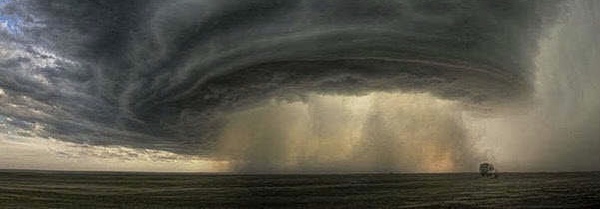
It can be the same for us, can’t it? In the midst of a storm, we remind ourselves of the love and power of God, but that doesn’t always make us feel better because it doesn’t make the storm go away. The problem may be that our perspective needs to change. Just as in the picture, the tornado and the rainbow can seemingly converge at the same spot–right where we are.

Psalm 77:10 is where Asaph’s perspective changes. “Then I said, “It is my grief, That the right hand of the Most High has changed.” He remembers who God is and what He has done. Suddenly his lamentations turn to praise. The trial has not abated for him, just his grief.

God does not promise that life will be easy, or that He will always take away our trials. But, He has promised that He will never leave us or forsake us. He may not always calm the storm, but He will give us all we need to weather it.

“Sometimes He holds us close, and lets the wind and waves go wild; Sometimes He calms the storm and other times He calms His child.” –Kevin Stokes and Tony Wood

Psalm 76 – God whom we fear

13 Tuesday Aug 2019

Posted by Tim Adams in The Psalms

≈ Leave a comment

Psalm 76 paints a picture of a fearsome God. That God is to be feared is all through Scripture, both Old and New Testaments, and I wonder if we are mindful of what it means to “fear the Lord”. We gather every Sunday morning and we sing songs praising Him for His love, His mercy, and His tenderness; but, how many songs do we sing praising Him for His fearsomeness?

We fear God for what He can do. We fear Him for what He has done. And, we fear Him for what He’s promised to do. For the unbeliever, this fear brings about denial and eventually trembling. For His children, fear of the Lord brings obedience and praise.

God’s fearsomeness is on display in His power, and His willingnees to use it. He demostrates His power in defense of His people. He uses His great power to bring about His intended ends. As we praise Him for His love, His mercy, and His tenderness, may we never forget that He is also to be feared.

← Older posts

Subscribe

  • Entries (RSS)
  • Comments (RSS)

Archives

  • October 2024
  • September 2024
  • July 2024
  • November 2023
  • June 2023
  • April 2023
  • March 2023
  • September 2022
  • March 2022
  • February 2022
  • November 2021
  • August 2021
  • March 2021
  • January 2020
  • October 2019
  • August 2019
  • July 2019
  • June 2019
  • April 2019
  • March 2019
  • April 2018
  • January 2018
  • October 2017
  • August 2017
  • January 2017
  • June 2016
  • October 2015
  • May 2015
  • February 2015
  • December 2014
  • August 2014
  • December 2013
  • August 2013
  • June 2013
  • May 2013
  • April 2013
  • February 2013

Categories

  • Hymns
  • Music
  • Romans 12:1-2
  • Something Different
  • The Church
  • The Psalms
  • Uncategorized
  • Upper Room

Meta

  • Create account
  • Log in

Blog at WordPress.com.

  • Subscribe Subscribed
    • ASCENTS - מַעֲלֶה [maʿaleh]
    • Already have a WordPress.com account? Log in now.
    • ASCENTS - מַעֲלֶה [maʿaleh]
    • Subscribe Subscribed
    • Sign up
    • Log in
    • Report this content
    • View site in Reader
    • Manage subscriptions
    • Collapse this bar
 

Loading Comments...